How to Use a Ticket Machine in Japan: Step-by-Step Guide With 8 Real Shops
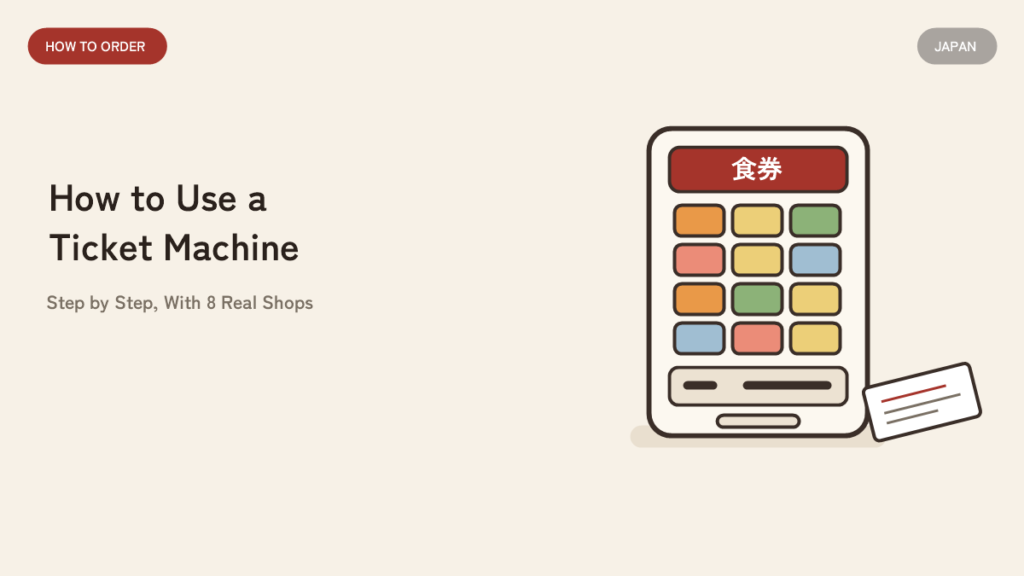
Walk into a ramen counter, a beef-bowl chain, or a standing soba stall in Japan and there is a good chance the first thing you meet is not a server but a machine. The shokken-ki (食券機, “meal-ticket machine”) is how a large share of casual Japanese restaurants take orders: you choose and pay at the entrance, the machine prints a small ticket, and you hand that ticket to the staff. Nobody asks what you want, and you never handle a bill at the table.
The system is simple once you have done it once, but the first time can be stressful: the buttons are often only in Japanese, there is usually a line behind you, and some machines will not take the note in your wallet. This guide walks through the process step by step, explains how to read the buttons, covers what kind of money older and newer machines accept, and then lists eight real shops on this site where you can expect to order from a machine, across Tokyo, Osaka, and Kyoto.
Why so many Japanese restaurants use ticket machines
Ticket machines suit small, fast-turnover shops. A ramen counter with eight seats and one or two cooks cannot easily spare someone to take orders, handle cash, and run a register. With a machine, payment is finished before you sit down, the cook simply reads the ticket, and the seat turns over as soon as you finish eating. That is why you will see them most at ramen shops, gyudon (beef bowl) chains such as Matsuya, standing soba and udon counters, curry shops, and fast tempura-bowl chains, and much less often at sit-down restaurants, izakaya, or sushi counters, where a server takes your order at the table.
For travelers, the machine is actually an advantage: you can order without speaking Japanese, the price of everything is shown before you pay, and there is no tipping or bill-splitting to worry about at the end.
How to tell a shop uses a ticket machine
Look just inside the door or right beside the entrance. The machine is usually a tall box covered in rows of buttons, often with food photos, and a slot for coins and notes. Some shops place it outside under the awning. If you walk past it and sit down, staff will usually point you back toward it, so if you are not sure, glance around the entrance before taking a seat. Shops that do not use a machine simply seat you and bring a menu.
Step by step: ordering from a ticket machine
- Put your money in first. On most older machines the buttons only light up once enough money has been inserted. Insert coins or a note, and the buttons for items you can afford will light up. On newer touch-screen machines you usually pick first and choose a payment method at the end.
- Press the button for your main dish. One ticket is printed per button press, so for a bowl of ramen plus a topping you will press two buttons and get two tickets.
- Add extras. Larger portions, toppings such as a seasoned egg, side dishes such as gyoza or rice, and drinks are separate buttons. Press each one you want while you still have credit left.
- Collect your change. Some machines return change automatically; on others you press the change button or lever, usually labeled おつり (otsuri, “change”), to get the rest of your money back. Check the coin return before you walk away.
- Take your tickets and hand them over. Give the tickets to the staff member at the counter, or place them on the counter in front of your seat. Staff often tear the ticket and may hand half back to you.
- Answer any follow-up questions. At some ramen shops the staff will ask about noodle firmness or richness when you hand over the ticket. At Ichiran you instead fill in a paper preference sheet at your seat. If you are not sure, “futsuu de” (“regular, please”) is always a safe answer.
Reading the buttons
There is no national standard layout, but a few patterns hold at many shops. The shop’s signature dish is often placed at the top left or given the biggest button, since that is where most customers look first. Main dishes tend to be grouped at the top, with toppings, sides, and drinks further down. A lit button means you have enough credit for that item; a separate lamp or a label reading 売切 (urikire) means that item is sold out for the day.
Even with no English, these common words will get you through most ramen and rice-bowl machines:
- ラーメン (ramen), つけ麺 (tsukemen, dipping noodles), 丼 (don, rice bowl), 定食 (teishoku, set meal)
- 大盛 (oomori, large portion), 並 (nami, regular), 小 (shou, small)
- 替玉 (kaedama, an extra serving of noodles, mainly at tonkotsu ramen shops) and 味玉 (ajitama, seasoned soft-boiled egg)
- トッピング (topping), 餃子 (gyoza), ライス (rice), ビール (beer)
- 食券 (shokken, meal ticket), おつり (otsuri, change), 売切 (urikire, sold out)
If the machine shows only text, a photo menu is often posted on the wall nearby, and many shops are used to tourists pointing at a picture and then at a button. Asking the staff “osusume wa?” (“what do you recommend?”) also works well.
Paying: cash, cards, and IC cards
This is where most first-time problems happen. Many older machines take cash only, and some do not accept larger notes such as the 5,000 or 10,000 yen note. Carrying a few 1,000 yen notes and some coins before you go out for ramen avoids the problem. If the machine rejects your note, the staff can usually break it for you; ask at the counter before you start.
Newer machines increasingly accept transit IC cards such as Suica or ICOCA, credit cards, and QR-code payments, but this varies from shop to shop and even between branches of the same chain. On this site, each restaurant page notes the payment methods we were able to confirm. For example, among the shops listed below, King-Emon in Dotonbori is listed as cash only, while Ichiran Shibuya’s machine is listed as taking cash, credit cards, and IC or mobile payment.
Common mistakes and how to avoid them
- Sitting down before buying. At a machine shop you buy first. If there is a line, the usual order is to buy your ticket and then wait for a seat.
- Forgetting the change. If change does not drop automatically, look for the おつり button before you leave the machine.
- Buying a topping without a main dish. Toppings and large-portion buttons are add-ons; you still need the main dish ticket.
- Holding up the line. If you need time to decide, step aside and let others go first. Photographing the machine and deciding while you wait in line is a common traveler trick.
Where to try it: eight shops on this site
The shops below are restaurants already listed on Japan Eat Guide whose ordering method is a ticket machine, according to the information on each restaurant’s page. They span Tokyo, Osaka, and Kyoto and range from inexpensive beef-bowl chains to ramen shops where you can build your bowl with toppings. Ordering details can change, so check the individual restaurant page and the shop itself before you go. For broader recommendations, see our ramen guide and the Osaka ramen guide.
Frequently Asked Questions
Do ticket machines in Japan accept credit cards?
It depends on the machine. Many older machines are cash only, while newer ones increasingly accept IC cards such as Suica or ICOCA, credit cards, and QR-code payments. Support can differ even between branches of the same chain, so check the restaurant page and carry some cash as a backup.
What if the ticket machine is only in Japanese?
Look for photos on the buttons or a photo menu on a nearby wall, and learn a few words such as ramen, oomori (large), and otsuri (change). Staff at shops popular with travelers are used to helping, so you can also point at a picture and ask.
What should I do if the machine will not take my 10,000 yen note?
Some machines do not accept larger notes. Ask the staff before you start; they can usually break the note for you. Carrying 1,000 yen notes avoids the problem.
Do I need to tip after ordering from a ticket machine?
No. Tipping is not customary at Japanese restaurants, and with a ticket machine you have already paid the full price before you sit down.
What happens if I press the wrong button?
Tell the staff right away, before your food is prepared. Whether a ticket can be swapped or refunded is up to each shop, so it is best to check the buttons carefully before pressing.
Quick Answer
At a Japanese ticket-machine (shokken-ki) restaurant you pay before you sit down: insert money first, press the button for your dish and any extras, collect your change, then hand the tickets to the staff. Many older machines are cash only and some reject 5,000 and 10,000 yen notes, so carry 1,000 yen notes and coins. No tipping, and no Japanese needed.
- BUDGET
- ¥1,000–3,000
- AREA
- Shibuya, Tokyo
Best for: The entrance machine is listed as taking cash, credit cards, and IC or mobile payment; you then set richness, noodle firmness, garlic, and spice on a paper sheet at your solo booth.
- BUDGET
- Under ¥1,000
- AREA
- Tokyo Station
Best for: An all-vegetable vegan ramen shop inside Tokyo Station, ordered from the ticket machine near the entrance like the other Tokyo Ramen Street shops.
- BUDGET
- ¥1,000–3,000
- AREA
- Tokyo Station
Best for: Seafood-tonkotsu ramen inside Tokyo Station, with the ticket machine by the entrance in the standard Tokyo Ramen Street format.
- BUDGET
- Under ¥1,000
- AREA
- Dotonbori, Osaka
Best for: A 24-hour Dotonbori landmark: buy a ticket at the cash machine by the entrance and hand it to the counter staff.
- BUDGET
- ¥1,000–3,000
- AREA
- Dotonbori, Osaka
Best for: Dark "Osaka Black" soy-sauce ramen, ordered from a cash-only ticket machine at the entrance.
- BUDGET
- ¥1,000–3,000
- AREA
- Dotonbori, Osaka
Best for: The same ticket-machine-plus-preference-sheet system as every Ichiran, at one of the chain's largest branches.
- BUDGET
- Under ¥1,000
- AREA
- Namba, Osaka
Best for: 24-hour beef bowls near Nankai Namba Station; the machine has photo buttons and is listed as taking cash and IC cards.
- BUDGET
- Under ¥1,000
- AREA
- Kawaramachi, Kyoto
Best for: Self-service ordering from a ticket machine near the entrance, in the fast format Matsuya uses chainwide, in central Kyoto.